
Articles
Articles from Temporary Ministries offer biblical reflection, practical ministry insight, and encouragement for faithful Christian living.
Our Updates subscribers receive these articles, as well as timely ministry news, book and speaking updates, and new resources. You can view everything on our Updates page and become a subscriber by using the Stay Connected section at the bottom of this page.
-
Are You a King?
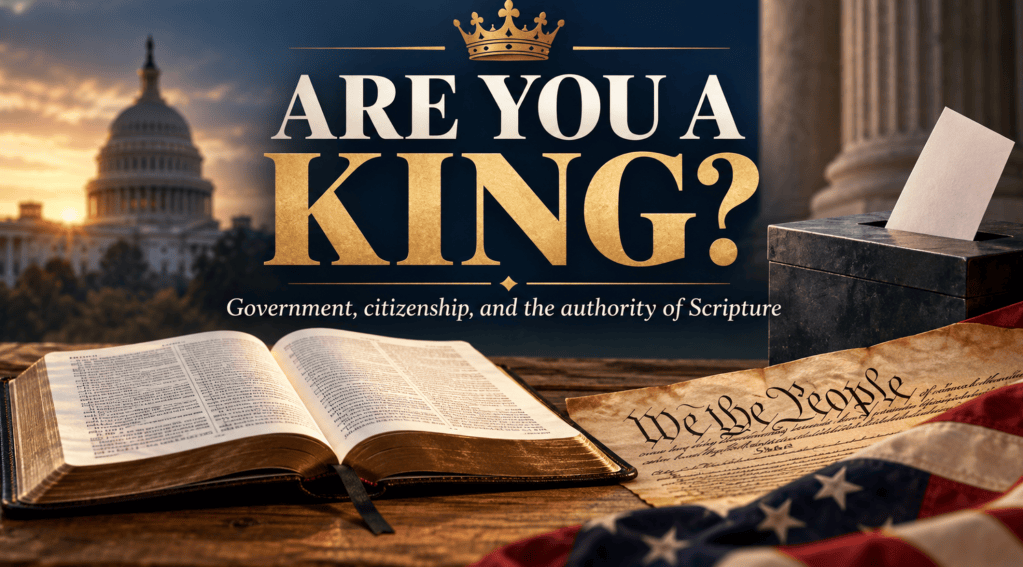
By David Beauchamp
As part of my ongoing ministry, I regularly engage with and interact with state legislators. When I meet with them, I will often begin by sharing Paul’s words in 1 Timothy:
“First of all, then, I urge that supplications, prayers, intercessions, and thanksgivings be made for all people, for kings…”
—1 Timothy 2:1–2 (ESV)At that point I stop.
I look at the legislator and ask, “Are you a king?”
I have never had one tell me that they were!
But then I explain that while they are not a king, they fulfill one of the roles historically exercised by kings.
Throughout the Bible, kings were leaders of civil government. Today, most nations no longer have kings, but the responsibilities once concentrated in a king still exist. Someone writes the laws. Someone executes the laws. Someone judges disputes. Someone commands the military. Someone represents the nation. And somewhere rests the political sovereignty from which governmental authority is derived.
I first learned of these six roles from Greg Baker of The Family Leader in Iowa. As I studied them, I found examples of each in the book of Daniel, particularly in King Nebuchadnezzar of Babylon, one of the most powerful rulers of the ancient world.
Daniel’s account gives us an interesting picture of what happens when these different powers of government are concentrated in one king.
1. The Lawmaker
Daniel 3 records Nebuchadnezzar erecting a massive golden image and commanding the people of his empire to bow before it when they heard the music.
Those who refused would be thrown into a fiery furnace.
Nebuchadnezzar established the rule and its penalty.
The king had exercised the power of a lawmaker.
That power exists in America, but it does not belong to one person. Article I of the United States Constitution establishes the legislative branch and vests federal legislative authority in Congress—the House of Representatives and Senate. State legislatures exercise similar authority within their states.
So when I speak to a state legislator and ask, “Are you a king?” the answer is obviously no.
But that legislator does exercise one of the governmental responsibilities once exercised by kings: making laws.
2. The Executive
Nebuchadnezzar also functioned as the chief executive of his government.
After Daniel interpreted the king’s dream, Nebuchadnezzar promoted Daniel, placed him over the province of Babylon, and appointed other administrators at Daniel’s request. Daniel 2:48–49 shows a king administering his kingdom and appointing people to positions of authority.
Someone has to carry out the laws and oversee the operation of government.
Article II of the Constitution establishes the executive branch and vests executive power in the president of the United States. At the state level, governors perform the principal executive role.
Again, power that once could be concentrated in a king has been separated and distributed.
3. The Highest Judicial Authority
Daniel 3 provides a disturbing example of another power Nebuchadnezzar possessed.
Shadrach, Meshach, and Abednego refused to obey the command to bow before the king’s image. Nebuchadnezzar heard their response, pronounced judgment, and ordered them thrown into the fiery furnace.
Notice what has happened in the same chapter.
Nebuchadnezzar established the rule.
Then Nebuchadnezzar judged those accused of violating it.
The same king exercised both powers.
Thankfully, American judges do not possess anything approaching Nebuchadnezzar’s unrestricted authority.
But the judicial function remains.
Article III establishes the judicial branch and provides for the judicial power of the United States, including one Supreme Court.
The function exists. The enormous difference is that our constitutional structure limits and distributes the authority.
4. The Commander of Armies
Daniel opens with these words:
“Nebuchadnezzar king of Babylon came to Jerusalem and besieged it.”
—Daniel 1:1 (ESV)Nebuchadnezzar did not merely govern from his palace. As king of Babylon, he commanded the military power of his empire and used it against Jerusalem.
Kings commanded armies.
That governmental function remains as well.
The Constitution makes the president Commander in Chief of the armed forces, although important military powers are shared with Congress—including Congress’s authority to declare war and raise and support armies.
This is another example of authority that could rest almost entirely with a king being divided within our constitutional government.
5. The Head of State
A king did more than make decisions. He represented his kingdom.
Daniel 4 describes Nebuchadnezzar being restored to his throne, honor, and position after God humbled him. His conduct mattered because he stood publicly before the people as their king.
Nebuchadnezzar’s experience illustrates the influence carried by the person who represents a nation. His pride, humiliation, restoration, and eventual acknowledgment of the “King of heaven” were not merely private experiences. They occurred in the life of the man who stood at the head of an empire.
Leadership has an exemplary dimension.
In the United States, the president serves as both chief executive and head of state. Governors perform comparable representative functions within their states.
But there is still one role of Nebuchadnezzar we have not discussed.
And this one changes the conversation.
6. The Sovereign
Daniel 3 actually illustrates several of Nebuchadnezzar’s powers at the same time.
He could erect a massive image, summon officials from across his empire, command the people to bow before it, establish punishment for those who refused, and then order that punishment carried out.
That is an extraordinary concentration of governmental power in one person.
Nebuchadnezzar was the sovereign.
So where is the sovereign in America?
Look at the first three words of the Constitution:
“We the People.”
That is not simply a memorable phrase.
The Constitution begins by locating the source of the governmental system in the people themselves.
This does not mean that “the people” are sovereign in the theological sense.
God is sovereign.
Nebuchadnezzar eventually learned that lesson himself. After being humbled, he declared that God’s works are right, His ways are just, and He is able to humble those who walk in pride.
But within the American political system, we operate according to the principle commonly called popular sovereignty: governmental authority ultimately derives from the people and is exercised through the constitutional institutions they have established.
Living in Kansas gives me an especially interesting historical connection to that phrase.
The Kansas-Nebraska Act of 1854 applied the principle of popular sovereignty to the question of whether slavery would be permitted in the Kansas Territory. Rather than Congress settling the issue, settlers were to determine whether slavery would be permitted. Pro-slavery and anti-slavery settlers rushed into Kansas, conflict became violent, and the period became known as “Bleeding Kansas.”
Kansas ultimately entered the Union as a free state.
That history also reminds us of something important: popular sovereignty does not guarantee that the people will always make wise, just, or even peaceful decisions.
Giving people political authority also gives them responsibility for how they exercise that authority.
That means something important happened when America rejected monarchy.
We did not eliminate the functions of the king.
We distributed them.
So What Does That Mean for Us?
Americans spend enormous amounts of time talking about presidents.
But presidents are not kings.
Neither are legislators.
Neither are judges.
The Constitution intentionally separates governmental authority among different branches and levels of government rather than concentrating it in a single ruler.
And citizens have a place in that system.
At regular elections, Americans choose representatives and other public servants at the federal, state, and local levels. Voting is one of the principal ways citizens participate in a government grounded in popular sovereignty.
For Christians, however, civic responsibility raises another question:
What authority guides the way we exercise that responsibility?
For evangelical Christians, the answer should begin with Scripture. The National Association of Evangelicals summarizes this conviction in the first point of its Statement of Faith:
“We believe the Bible to be the inspired, the only infallible, authoritative Word of God.”
That conviction matters far beyond what happens inside a church building. If Scripture is authoritative, then biblical truth should shape the way Christians think about every area of life—including our participation in civil government.
That does not mean the Bible gives us a candidate list or tells us how to mark every line on a ballot.
It does mean that Christians should not allow political parties, personalities, advertising, public opinion, or even personal preference to become our highest standard.
Scripture should inform our understanding of what is good, what is evil, what is just, what is true, and what promotes the good of our neighbor.
Applying those truths to particular candidates and public policies may require wisdom, careful judgment, and sometimes difficult choices. But for the Christian, the starting point should not simply be, “What does my party say?” or “What do I want?”
A better question is:
“What has God said?”
For Christians, that creates worthwhile questions.
How should I steward the political authority entrusted to me as a citizen?
What biblical truths should guide the way I think about the people and issues before me?
How should Scripture inform the way I evaluate public servants and issues?
How do I participate without allowing politics to become my hope?
How do I disagree with my neighbor while still loving my neighbor?
And how do I remember that the person for whom I vote—or against whom I vote—is never the ultimate answer to the problems of this world?
Christians can reach different conclusions about candidates, policies, and even the wisest way to exercise their civic responsibilities.
Political participation should never become a substitute for the gospel, and an election victory should never be confused with the advance of God’s Kingdom.
Biblical authority does not require Christians to pretend every political question is simple.
It does require us to take truth seriously.
Understanding our form of government should also cause us to think seriously about the responsibility that comes with citizenship.
The people who appear on our ballots are not kings.
They are being considered for particular responsibilities within a government whose authority is intentionally divided.
And those of us who hold ballots are not kings either.
Yet within the American constitutional system, “We the People” have been entrusted with a role.
For Christians, that role should be exercised not merely as citizens of a nation, but as people who first recognize the authority of God and His Word.
The question is what we will do with it.
Ultimately, every president, governor, legislator, judge—and every citizen—lives under a King far greater than any earthly ruler.
That is why Paul’s instruction remains important:
Pray for kings.
Pray for those in authority.
But in America, perhaps the question is broader than that. Governmental authority has been distributed, and through popular sovereignty, every citizen has been entrusted with a role.
So perhaps the question I ask legislators is also a question worth asking ourselves:
“Are you a king?”
-
Not Every Season Is a Harvest Season

Months ago, there was a field near our home showing fresh green growth. I watched those plants become very tall corn stalks. Now the stalks are still standing, brown and ready for harvest.
Not every season is a harvest season.
There are seasons for planting, seasons for watering, seasons for waiting, and seasons for gathering. The same is true in life and ministry.
Sometimes we serve faithfully and see immediate results. Other times, we pray, encourage, teach, love, and invest in people without seeing much change at all. Not seeing results can be hard.
That does not mean nothing is happening.
Paul wrote:
“I planted, Apollos watered, but God gave the growth.”
— 1 Corinthians 3:6 (ESV)Our responsibility is not to force the harvest. It is to be faithful in the season God has placed us in.
If this is a season of planting, plant well.
If it is a season of watering, keep watering.
If it is a season of waiting, keep trusting.
And when harvest comes, give God the credit.Not every season is a harvest season, but every temporary season can be a faithful one.
– David Beauchamp
Temporary Ministries
-
What Are Readers Saying About Leading Through the Noise?
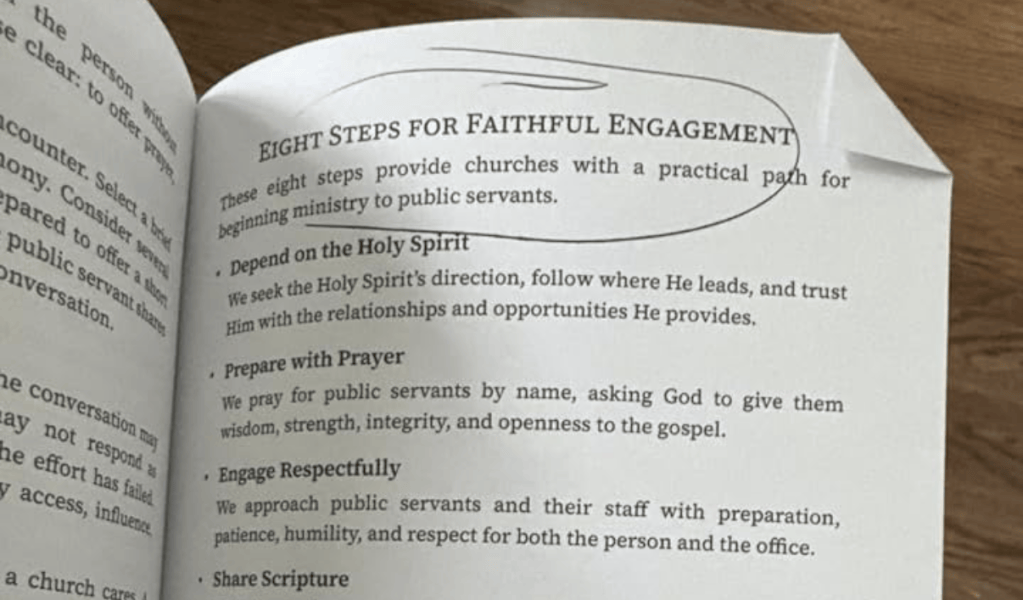
Amazon recently generated a summary of customer reviews for Leading Through the Noise: A Biblical Path for Churches in a Polarized Age.
Its summary highlighted three themes readers are consistently identifying:
- a biblical model of engagement
- a clear and readable approach
- practical guidance for engaging public servants
Amazon also noted that readers described the book as gospel-centered, nonpartisan, practical, and one reviewer summarized the book this way:
“Every public servant and every Church leader should read this book!”
I am grateful that readers are recognizing what I hoped to accomplish: helping churches and Christians engage governing authorities faithfully without allowing partisan politics to overshadow the gospel. You can read the Amazon reviews here:
If you have not explored the book yet, you can learn more by visiting the Temporary Ministries Books page.
— David Beauchamp
Temporary MinistriesExplore more from Temporary Ministries and subscribe at https://temporaryministries.org.
-
Faithfulness Without Knowing the Outcome
When I began working on my doctoral dissertation, I had no idea what the outcome would be. I believed God had led me to pursue it, so I moved forward, trusting Him with the results.
After completing the dissertation, I felt led to transform it into a book, Leading Through the Noise: A Biblical Path for Churches in a Polarized Age.
Once again, I didn’t know what the outcome would be. Would anyone buy the book? Would anyone even read it?
I didn’t write the book to make money. I wrote it because I believed God was guiding me to do so. My responsibility was to be faithful to what He had placed before me.
The apostle Paul reminds us:
“Moreover, it is required of stewards that they be found faithful.”
— 1 Corinthians 4:2 (ESV)
I certainly hope the book will encourage people and help churches navigate our polarized world. But I cannot control those results.
What I can do is faithfully follow God’s leading and entrust the outcome to Him.
Faithfulness is not dependent on knowing the outcome. It is demonstrated by obedience along the way.
– David Beauchamp
Temporary Ministries
-
Noise, Stillness, and What Matters Most

Noise.
For much of my adult life, I have lived around noise. As an Army chaplain, I served six combat deployments to Iraq and Afghanistan. During those years I spent more than my fair share of time aboard military aircraft.
Few environments are noisier than the inside of a C-130 preparing for an airborne operation. The engines roar. Equipment rattles. Soldiers exchange last-minute instructions. Jumpmasters communicate through shouted commands and hand signals because normal conversation is impossible.
I experienced that noise many times while waiting to jump from an aircraft. Later, as a jumpmaster myself, I learned to shout commands as loudly as possible while making deliberate hand signals to ensure every paratrooper understood what to do.
Then came the moment of exit.
After stepping from the aircraft and feeling the parachute open overhead, everything changed. The noise disappeared. Suspended beneath a canopy, floating toward the earth, there was an unexpected stillness. The contrast between the chaos inside the aircraft and the quiet of the descent was remarkable. In the stillness, it became easier to think clearly and pay attention to what mattered most.
Noise makes it difficult to concentrate. It becomes hard to distinguish what matters from what does not. In an aircraft preparing for an airborne operation, that challenge can affect safety. In our present cultural moment, I believe it affects something just as important: our ability to think and respond biblically.
The United States is experiencing a period of deep political and cultural division. Distrust is growing, public rhetoric is increasingly hostile, and many people feel pressure to choose sides.
Christians are not immune to these pressures.
Some believers have chosen to withdraw completely from public life, hoping to avoid the controversy. Others have become entangled in partisan politics, viewing political victory as the primary path to cultural renewal. Still others are searching for a way to engage governing authorities that remains faithful to Scripture and centered on the gospel.
The result is noise—constant, unrelenting noise.
And that noise creates a problem. It becomes increasingly difficult for Christians and churches to discern how they should faithfully interact with governing authorities. Many believers know what they are against, but fewer are confident about what they are for. Some retreat from public life altogether. Others become so identified with political causes that their gospel witness is overshadowed. In the midst of the noise, many Christians are simply unsure how to proceed.
Churches feel pressure to take sides. Christians are often told that if they are not fully committed to one political camp, they must not care. Faithful believers can face criticism regardless of what position they take or what actions they pursue.
Many people long for the quietness of that parachute descent. They would prefer to escape the noise altogether.
But we do not have that option.
God has placed us in this moment, among these challenges, and among the people who need the hope of the gospel. The question is not whether Christians should engage the world around them. The question is how.
Excerpt from the Preface of Leading Through the Noise: A Biblical Path for Churches in a Polarized Age by David Beauchamp.
© 2026 by David R. Beauchamp. All rights reserved.
To learn more about the book, visit the Leading Through the Noise page on Temporary Ministries.

